Showing posts with label General safety. Show all posts

Friday, 10 June 2016

Poster of the Month, June 2016: Preventing foot and ankle injuries


DON'T DO THE TWIST!


To prevent foot and ankle injuries,
wear sensible shoes and watch your
step – especially on uneven floors


If you find flaws in our floors, please report them


June's Poster of the Month is about preventing foot and ankle injuries in the workplace.

Coincidentally, a couple of months after I researched and wrote the words for this poster, this story came out in the news. It concerned a receptionist who was sent home from her job for refusing to wear high heels.

Her refusal was not without good reason. She claimed that her work involved nine hours on her feet, escorting clients to meeting rooms, and that she would be unable to do this wearing heels.

After posting the details of her experience on Facebook, the receptionist realised that other women had been put in the same position. The women in question were not all in desk jobs. Many were required to stand for long periods; some had to walk long distances, including up and down stairs; some had to carry heavy items; and some even had to run across shiny, slippery floors carrying emergency equipment.

It was after hearing some of these stories that the receptionist decided to start a petition to change the law, so companies can no longer legally insist on high heels as part of their dress code.


What's wrong with sensible, comfortable footwear?

High heels are well known for causing severe discomfort, ankle injuries and posture problems. They can also make you unsteady on your feet, more susceptible to slips and trips and more likely to fall over.

For jobs that involve long periods of standing, walking and carrying, we always recommend flat, comfortable shoes with good treads. Where there are additional threats from falling items or vehicle movements, proper safety shoes with steel toe caps are vital.
 

Having worked in health and safety for more than ten years, I'm appalled that women are allowed to wear heels in some jobs, let alone forced to.

Kodiak has many more workplace posters on the subjects of PPE; safety shoes; and slips, trips and falls.

To find out more, please give us a call on 01530 456 000.

Thursday, 8 October 2015

Poster of the Month, October 2015: The dangers of acting on instinct


In the wild, animals use their instincts to survive 

In the workplace, acting on instinct can be dangerous

Never act on first instinct, always take the time to think!


October's Poster of the Month is about acting on instinct and how this can be dangerous — especially in a workplace environment.


What does it mean to act on instinct?


Acting on instinct can be a split second reaction that results in a serious accident. 

The example on the poster shows a man who has dropped his key down a hole. He has reacted instinctively, by kneeling down and reaching his hand into the hole, but he hasn't stopped to wonder what else might be down there. 

Other examples may include:

  • A worker who spots an item that is about to fall and instinctively reaches out to grab it. Unbeknown to the worker, however, the item is really heavy, red hot or razor sharp.
  • A driver who swerves to avoid a pigeon on the road and ends up colliding with a another vehicle.
  • A machine-operator, whose machine suddenly jams and shuts down, instinctively reaches into the machine to remove the blockage. However, as soon as the jam is cleared, the machine starts up again with his/her hand still inside.


Instinct is a natural reaction.


So how can we influence workers to override their instincts and stop them from doing what comes naturally?

  • Build a 'safety first' culture, where safety is always prioritised;
  • Highlight potential dangers in the workplace to raise awareness and increase caution;
  • Regularly remind employees of safe practice and procedure e.g. lock out, tag out where machinery is concerned; and
  • Draw attention to the specific dangers of acting on instinct and remind employees to always think before taking action.


A split second's thought could save an accident report.

Kodiak's poster subscription service is an effective and inexpensive way to promote safety in your workplace.

Our ever-changing posters regularly address workplace safety issues, stress the importance of adhering to procedure and highlight the dangers of acting on instinct.

To find out more about how our posters can help you improve safety and reduce accidents, please call us on 01530 456 000 or email enquiries@kodiak.co.uk

Friday, 5 June 2015

Poster of the Month, June 2015: Problem lighting in the workplace


FLASHING LIGHTS?

Flickering lights do not provide enough light to work safely

The continual flashing can also trigger headaches and migraines


Bring problems to light and report problem lighting to your supervisor


June's Poster of the Month deals with the issue of problem lighting.

Lighting is an important feature of any workplace as it helps employees to see clearly, work safely and exit the building promptly in an emergency.

Problem lighting may include:

  • Dead, dirty or dim bulbs that do not provide proper illumination
  • Flashing or flickering lights that could cause headaches and migraines
  • Coloured lighting that impairs your ability to distinguish colours
  • Lights that cause excessive shadows, reflections or glare
  • Broken bulbs or covers that could contaminate your products or environment
Employees should report problem lighting for repair or review.


Kodiak posters regularly cover workplace lighting and the safety issues associated with it. 

If you need posters on this subject, we have a wide range available via our sales team.

For more information, please call us on 01530 456 000 or visit our website: www.kodiak.co.uk

Thursday, 5 February 2015

Poster of the Month, February 2015: Changes in the law on drug driving


DRUG DRIVING — the law is changing


From March 2015, it will be a criminal offence to drive with more than trace amounts of drugs in your system

Offenders will face a £5,000 fine, up to six months in prison and an automatic 12-month driving ban

Drugs and driving are a dangerous combination


February's Poster of the Month concerns changes to the law on drugs and driving. These changes will take effect from March 2015.

Taking illegal drugs increases the risk of a serious or fatal crash.

It is estimated that drug driving could be responsible for up to 200 deaths every year. The effects of illegal drugs are unpredictable as they are unregulated and affect individual people differently.


According to Brake, the risk of a serious or fatal crash increases:
  • up to 4 times if the driver has taken cannabis;
  • 2–10 times if the driver has taken cocaine / illegal opiates;
  • 5–30 times if the driver has taken multiple drugs; and
  • more than 23 times if the driver has combined illegal drugs with alcohol

All of these statistics apply when compared to a driver who is drug-free and sober.

Medical drugs can also be risky.

Medical drugs can impair driving ability by causing drowsiness or affecting the driver's vision, coordination or concentration.

Specific examples include:
  • cough and cold medicines
  • decongestants 
  • sleeping tablets
  • anti-histamines 
  • anti-inflammatories
  • anti-depressants
  • anti-biotics
  • epilepsy medication
  • hayfever and allergy relief

Medication that affects a person's ability to drive or operate machinery is required to carry a warning. However, many drivers are unaware that such medications carry a risk. Research shows that one in six UK drivers ignores such warnings or fails to check the label at all.

Kodiak posters regularly cover drug driving — including both illegal and medical drugs. 

If you need posters on these subjects, we have a wide range available via our sales team.

For more information, please call us on 01530 456 000 or visit our website: www.kodiak.co.uk


Wednesday, 5 November 2014

Poster of the Month, November 2014: Do you have the right training, experience and equipment to do the job?


USE YOUR HEAD

Always ensure you are trained, experienced 
and have the right tools for the job

Anything less just won't cut it!

November's Poster of the Month is a humorous one about making sure you have the right training, experience and equipment to do the job.


The right training provides essential awareness

When employees undertake training, they are taught the correct and safe way to do the job. 

They also learn what not to do — and about the potential consequences of doing things wrong.

Training can make your employees look at a task in a completely different way and appreciate the risks in ways they never could before.

Working without training can lead to disaster

If an untrained employee attempts to do something without the necessary training — for example, driving a forklift truck — they won't have the same awareness and they will be more likely to cause an accident.

In fact, untrained forklift operators are one of the leading causes of forklift accidents.

Using the wrong tools can be dangerous too

Using a screwdriver to prise open a can of paint might be okay. But try using a stanley knife and the brittle blade could snap and cause a serious injury.

Likewise with any tool that is too big or powerful for the job that is being attempted.


Kodiak posters regularly cover training, experience and using the right tool for the job. 

If you need posters on this subject we have a wide range available via our sales team.

For more information, please call us on 01530 456 000 or visit our website: www.kodiak.co.uk


Monday, 27 October 2014

Chemical labels: Do your employees know what they are dealing with?


1.

 2.

 3.


Exposure to chemicals can have devastating consequences

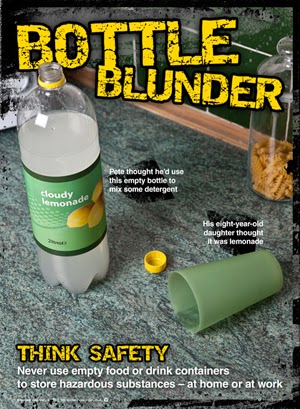
This story shows how corrosive dishwasher fluid, which should have been safely locked away, was mistaken for orange juice. The incident led to one death and agonising injuries for five other individuals.

Cancer Research UK reports that occupational exposure to cancer-causing chemicals is responsible for around 4% of cancer cases in the the UK.

The HSE reports that in 2012 there were an estimated 179 new cases of occupational asthma, mainly caused by exposure to hazardous substances.


Chemical labelling is vital to employee safety

Chemicals are an essential part of daily life, both at work and at home, and need to be handled with care.

If your employees use, transport, manufacture or dispose of chemicals, they could be at risk. A clear label helps them to easily determine what the chemical is and what the risks are when handling it.

Risks of mishandling chemicals include:
  • Fire
  • Explosion
  • Poisoning
  • Radiation
  • Dermatitis
  • Chemicals burns
  • Asthma/respiratory problems
  • Blindness
  • Cancer
  • Damage to the environment


Handling chemicals correctly can help to prevent accidents, injuries and disease

When handling chemicals, employees should:
  • Ensure they are trained and authorised to do so
  • Always check the label, so they know what chemical they are dealing with
  • Report items with missing or unclear labels
  • Refer to the risk assessment or Safety Data Sheet for further guidance
  • Wear appropriate Personal Protective Equipment (PPE)
  • Handle the chemical in a safe/designated area with suitable ventilation
  • Take steps to protect those working around them
  • Take care to avoid spills
  • Dispose of chemicals correctly, according to guidelines

When storing chemicals, employees should:
    • Report items with missing or unclear labels
    • Store chemicals correctly in the designated area
    • Keep chemicals in their original containers, wherever possible
    • Never use empty food or drink containers to store chemicals
    • Label alternative containers correctly, for example if the original container is damaged and needs to be replaced

    Kodiak's posters regularly deal with issues relating to chemicals, including safe labelling, handling, storage and disposal.


    If you would like to find out more about how our posters could help you improve chemical handling, please call us on 01530 456 000.


    Wednesday, 1 October 2014

    Poster of the Month, October 2014: Dealing with hazards in the workplace


    WARNING SIGNS

    We can't remove every hazard from our workplace, but we can:

    1. Warn others of the hazard
    2. Isolate the hazard
    3. Control the hazard
    4. Direct others to avoid the hazard

    Respond to hazards quickly and carefully or it could be the end of the road


    October's Poster of the Month looks at ways of tackling workplace hazards, using road signs to illustrate each example.

    In an ideal world we could eliminate all the hazards that make our workplaces dangerous but, in the real world we can only acknowledge them and deal with them appropriately

    What is a hazard?

    According to the HSE:

    "A hazard is something (e.g. an object, a property of a substance, a phenomenon or an activity) that can cause adverse effects."


    Examples may include:

    • a newly washed floor, or accidental spill, that could cause a slip hazard
    • working with hazardous materials, for example in a paint spray shop
    • excessive noise, which could cause hearing damage
    • maintenance or renovations happening in one part of the building

    Dealing with hazards

    As the poster points out, there are different ways of dealing with different hazards. The following are examples of how this advice might be put into practice.

    1. Warn others of the hazard
    • Make sure all permanent hazards are highlighted with appropriate signage, such as warning signs, no-entry signs, mandatory PPE signs etc
    • Supervise visitors correctly — advise them of hazards and make sure they wear appropriate PPE while on site
    • Use temporary signs for temporary hazards, such as putting out a wet floor sign after washing the floor

    2. Isolate the hazard

    • Isolate areas where hazardous activities take place and specify that only authorised personnel are allowed to enter
    • If possible, block off areas where there are temporary hazardous conditions, such as areas where outside contractors are working 

    3. Control the hazard

    • Ensure employees adhere to the site rules and wear the correct PPE when carrying out hazardous tasks
    • Advise employees to make sure their PPE is fit for purpose — it should fit them properly and be in good condition
    • Ensure chemicals are labelled correctly and that safety data sheets are available for supplementary advice and information on the chemicals in use

    4. Direct others to avoid the hazard

    • Use no-entry or authorised personnel only signs to prevent unauthorised access to hazardous areas
    • Use authorised cordons, cones and diversion signs to block, and direct people away from, temporary hazardous conditions
    • Use clearly marked walkways to segregate pedestrians from vehicle movement areas and dangerous or moving machinery

    Kodiak Industrial regularly produce posters on all of the above subjects. We also produce a range of hazard warning signs, including custom-made signs.

    Visit our website to find out more about how our posters and our workplace poster programme can help you address hazards in your workplace.

    Alternatively, give us a call on 01530 456 000 to discuss your needs.


    Wednesday, 10 September 2014

    The dangers of smart-watches and driving


    We all know about the dangers of mobile phones and driving

    Statistics from Think! show that if you use a mobile phone while driving, your reaction times are around 50% slower and you are four times more likely to crash.

    Since 2003 it has been illegal to use a handheld mobile phone while driving. However, even with the ban in place, the Daily Mail reports that one in four car accidents is still caused by using a mobile while driving.

    Today, drivers who are caught can expect to receive an automatic fixed penalty notice, which means three penalty points on their driving licence and a £100 fine.

    If a driver's case goes to court he/she could be disqualified from driving and be fined up to £1,000. For drivers of buses or goods vehicles, the maximum fine goes up to £2,500. 

    The risk of using a smart-watch while driving could be even greater

    Using a mobile phone when driving slows your reactions and increases your risk of crashing because your full concentration is not on the road.

    If you use a handheld device the risk is greater because not only is your concentration compromised, but you are also driving one-handed and without full control of the vehicle.

    So, imagine using a smart-watch while driving. 


    How many hands do you have on the wheel now?

    While a phone can be put down, turned off or silenced, a watch is always there and constantly accessible, with alerts popping up and messages just waiting to be answered. 

    And if you're constantly tempted to look at it, to press its buttons and to read its tiny screen, your eyes won't be on the road.

    Smart-watches are already available to buy

    With some smart-watches already on the market, and the Apple Watch due to be released next year, they are already set to turn into the next must-have piece of technology.


    It's time to take action

    If you have employees who drive — professionally or otherwise — they should be aware of the dangers. Not only the risks of using a smart-watch themselves while driving, but also the risk of driving on roads where other drivers may be distracted.

    Our hard-hitting poster could help you get the message across

    To help our clients raise awareness of the dangers of smart-watches, we have produced a poster on the subject.


    Promoting safe driving

    At Kodiak Industrial we produce many posters on safe driving and avoiding collisions. 

    If you employ drivers, our posters could help you to highlight common dangers, recommend good practice and encourage safer driving.

    Just some of the subjects we cover on a regular basis include:
    • checking mirrors and blind spots
    • staged accidents and insurance fraud
    • lights and signals
    • occupational road risk
    • anticipation and reading the road
    • avoiding rear-end shunts
    • speeding
    • seasonal driving
    • the dangers of mobile phones and driving
    • stationary objects such as railings, bollards and lamp posts
    • cyclists, pedestrians and other vulnerable road users


    To find out more, visit our website: www.kodiak.co.uk or give us a call on 01530 456 000.