Showing posts with label Waste reduction. Show all posts

Wednesday, 15 October 2014

Seven wasteful habits and ways to stop them

1.

2.

3.


There is a strong focus on 'Zero Waste' in the media at the moment. Households are trying to achieve it, businesses are trying to achieve it and, in America, whole towns are trying to achieve it.

Zero Waste is a philosophy that encourages reuse and recycling in a way that emulates the process of nature, so that nothing goes to waste. The aim is to cut out all waste that goes to landfills or incinerators.

It's an overwhelming task, which is changing how we think about everything — from original materials and processes to reusing, recycling and repurposing.

In reality, the waste that ends up in landfills and incinerators is only part of the problem for businesses. Not all waste is physical waste that we can see when we look in the dustbin. There is also wasted time, wasted effort and wasted energy. 

If you are looking into new waste reduction initiatives, here are ten habits you might need to stop.


1. Mistakes

Avoidable errors waste time, materials and energy. From manufacturing errors to driving collisions, every company has the capacity to make mistakes and make less of them.

It's much easier to build quality into your process than to find and deal with mistakes that have already been made. 

Cultivate an environment where employees feel more responsible for the work they do and the waste they create. Invite their suggestions for reducing mistakes and waste. Reiterate the need to concentrate fully on the task in hand and to check their work at each stage of the process.

2. Excess

Any activity that involves using or producing too much. From idling engines and machines, to manufacturing overproduction.

Remind employees to turn equipment off when it is not needed and to follow spec sheets and instructions carefully.

3. Idle time 

Waiting for people or things that are missing or not ready wastes time. If you have too much idle time, look at your processes and identify any bottlenecks. 

For example, make sure that:
  • The workspace is organised efficiently, with a designated place for everything;
  • Tasks are being completed in the correct order;
  • There is sufficient planning and preparation;
  • There are enough people working on each stage of the process; and
  • There is sufficient equipment available for people to work with.

4. Movement

If your employees are having to make too many unnecessary journeys around your workplace this can waste time, effort and energy.

To remedy the problem:
  • Talk to your employees to identify where the problems are;
  • Store items your employees need most frequently in a more accessible place;
  • If certain items are often used together, store them near to each other if you can; and
  • Encourage employees to consolidate their journeys to save time.

5. Mishandling


Mishandling is damage caused by carelessness. It could be anything from knocking a wing mirror off a vehicle, to a forklift colliding with boxes, or a manufacturing machine breaking after being used incorrectly. 

If mishandling is a common problem in your workplace there may be specific things you need to address. For example, repeated forklift collisions might be a result of a badly laid out space. A machine that keeps breaking during use, may have a recurrent fault or your operators may need refresher training.

If and when incidents occur, talk to your employees to find out how they happened and try to solve persistent problems.

6. Wrongful disposal

Are your employees throwing things away that are not technically rubbish? For example, used boxes that could be refilled, 'empty' containers that are not actually empty, or recyclables that should go in the recycling bin?

If so, why are they doing this? Do they know what they should be recycling? Is your recycling system difficult to understand? Are your recycling bins in a less convenient place than the normal rubbish bin?

Most such problems can be remedied simply, with a little reorganisation or re-education. Make sure employees are clear about what is expected of them and what their responsibilities are.

7. Using substandards

You can waste time and energy by using or processing substandard materials. For example, using a broken pallet to transport goods could result in the goods falling and being damaged. Likewise, you can waste time and effort by processing substandard materials that will only lead to a substandard product.

Running defective machinery can, primarily, be unsafe. It can also waste materials and energy.

The solution to all of these problems is better checking methods:


  • Check the quality of goods-in before you store them away and then again before you process them;
  • Check the condition of pallets etc. before use; and 
  • Check machines, vehicles and equipment are safe to use and running efficiently.


As you can see, many of these issues can be remedied by improved communications.

This is where Kodiak's workplace poster programme can help, by continually reminding your employees of the protocol around waste and recycling.

If you would like to find out more about Kodiak and how we could help your business to reduce waste, please visit us at www.kodiak.co.uk or call us on 01530 456 000.

Monday, 1 September 2014

Poster of the month, September 2014: The power of ideas in the workplace


EVERY IDEA is a foundation just waiting to be built on

This is the first of a new series of monthly blog articles we will be posting.

Every month our design studio personnel will choose their favourite poster of the month and we will share it with you here.

September's poster of the month (shown above) is about developing ideas.

Good ideas lead to great improvements

When planning a project or improvement initiative, talk to your staff.

Your staff are the people who:
  • deal with your customers first-hand
  • experience problems and difficulties in your workplace
  • are aware of the dangers and hazards in your workplace
  • get frustrated when things are too awkward or complicated
  • understand how your current methods waste energy, materials and time
Their input and ideas could help you develop:
  • improvements to customer service and the customer experience
  • solutions to persistent problems
  • a safer environment and safer working practice
  • more streamlined systems that are easier to operate
  • initiatives to save energy and reduce waste

For more poster examples, please visit www.kodiak.co.uk

Tuesday, 15 November 2011

The importance of planning

Large workload posters
1
Planning posters
2
Forethought posters
3


Whatever the job, planning is a vital ingredient. Whether you are a bus driver planning a manoeuvre or an industry worker planning to manufacture a batch of products.

While some might think it is quicker and more productive to dive straight in and get on with the job, those with more experience understand the value of thinking things through and being suitably prepared.

Here are three things your employees should be asking themselves before starting work.

1. Have I checked the details?
Your employees need to know exactly what is required and what is expected of them. The manufacturing spec sheet should specify all the materials, equipment, processes/settings, quantities and deadlines.

Drivers should know their route and what to do in the event of a diversion or other unexpected event.

Referring to the details regularly ensures that the task is completed successfully and with as few errors/mishaps and as little waste as possible.

2. Do I have enough materials?Whether it's raw materials for use in production or fuel for a vehicle — it's always important to check there is enough to do the job and a contingency just in case something unexpected happens.

3. What can I prepare in advance?When a deadline is involved, anything that can be done to save time is a bonus. It might be organising equipment, gathering materials together, part-assembling products or clearing away clutter/waste that might get in the way.

Planning the job properly means there is less scope for making errors. Fewer errors ultimately means the job takes less time, creates less waste and incurs less cost.

For employees in industry, planning the job makes things easier by keeping tools and materials to hand and spreading the work more evenly over the time period. This, in turn, reduces last-minute pressure and stress, which can often lead to mistakes.

For drivers, planning a manoeuvre allows a full assessment of the space, surroundings and potential hazards. A well-planned manoeuvre is less likely to result in a collision or damage to the vehicle.

So, in short, planning is important for safety, quality control, waste reduction, timing, cost maintenance, error reduction and to ease stress and pressure.

Kodiak's motivational poster programme regularly covers the importance of planning. 

If you would like to find out more about how our posters can help your employees to plan their work more effectively, please contact us.


For daily tips on dealing with common workplace issues, why not follow us on Twitter.
If you would like to find out how Kodiak posters 
can help your business work smoother, smarter 
and safer, please call us on: 01530 456 000 
or email us.

Tuesday, 4 October 2011

Saving energy: Five ways to cut carbon, consumption and costs

Energy-saving posters
1
Defective equipment posters
2
Leaky pipework posters
3


In the current economic climate it is more important than ever for businesses to reduce their overheads. Saving energy is a good place to start.

Here are five simple tips to help you cut carbon, consumption and costs.

1. Switch off at nights and weekends
It might sound obvious, but companies still waste thousands of pounds by leaving equipment switched on overnight.

The Carbon Trust has reported that office equipment is the fastest growing area of business energy consumption – it accounts for around 20% of total energy use.

Computers and their monitors are some of the worst offenders. Turning off your company's PCs at evenings and weekends could cut your running costs by more than two thirds.

Switching off vending machines, printers and water coolers during these times can also reduce their energy use by as much as 70%.

Endeavour to switch off all equipment at night and turn off any machines without on/off switches at the plug.

2. Don't leave equipment idling
You can make even more savings during the day by making sure equipment is not left running for nothing.

An idling hosepipe, for example, can waste up to 18 litres of water every minute. If it isn't in use, the tap should be turned off.

A computer screen can use as much energy when displaying a screensaver as it does during normal use. If you switch it to sleep mode instead, you could cut its energy consumption by up to 70%.

Chargers and adaptors should be turned off unplugged as soon as equipment has charged and whenever they are not in use.

3. Report defective equipment
Equipment and vehicles can waste both energy and resources if it not running properly or efficiently. A faulty piece of equipment may also present a risk to safety.

Defects may worsen during prolonged use and this may make the equipment more difficult and costly to repair.

Employees should be alert for any strange noises, changes in handling or process problems.
First-use checks should be carried out before using any vehicle or piece of equipment and any problems tshould be reported.

If a fault develops during operation, it should be reported immediately and further use should be suspended until the problem is addressed by a qualified service person.

Any defective equipment should stay out of service until the problem is rectified or until it is authorised for use.

4. Report leaks
Most leaks are a sign of energy wastage. They may come from a range of sources including dripping taps, perished hoses, cracked tanks, broken pipes and defective machinery.

Leaks may include steam/vapours, oil, fuel or water. Extra care should be taken if any leaked material also poses a fire hazard or slip risk.

Employees should be alert for visible steam, dripping liquids, puddles on the ground, sounds of air or liquid escaping and any drop in pressure from equipment they are using. Again, the advice is to report the problem as soon as possible.

5. Ask for suggestions
Employees working directly with your equipment, vehicles and machinery are generally more aware of the waste that is being created and often have clever suggestions that could help reduce it.

Asking your employees for help and ideas is proven to make them feel more valued and can improve their performance at work, so it could be a win-win situation.

Kodiak's motivational poster programme regularly deals with energy saving and waste reduction.
If you would like to find out more about how our posters can help your company save energy, please contact us.


For daily tips on dealing with common workplace issues, why not follow us on Twitter.
If you would like to find out how Kodiak posters 
can help your business work smoother, smarter 
and safer, please call us on: 01530 456 000 
or email us.


Tuesday, 5 July 2011

Fuel economy and the importance of eco-driving


Fuel saving poster
1
Posters on saving fuel
2
Posters on wasting fuel
3

Sky News has reported today that more than a million drivers have given up their cars over the past year due to rising fuel costs. Of those who continue to drive, 45 percent have reduced the amount of driving they do, 10 percent have exchanged their car for a more fuel-efficient model and 7 percent are now car-sharing.

It's good news for the environment, but it isn't hard to see why such action is being taken. The latest figures from the AA show that the average prices of unleaded petrol and diesel have increased by 42% and 43% respectively since June 2006.

As fuel prices increase, so do transportation costs and, consequently, so does the cost of living. So it's not just motorists who are affected – it's everyone.

At Kodiak we have been extolling the virtues of eco-driving for years. As well as reducing fuel consumption and costs, it also reduces carbon emissions – making it a greener way to drive. Nowadays eco-driving, and the advice that goes with it, is a necessity for any company that uses vehicles – whether it's one company car or a fleet of trucks or buses.

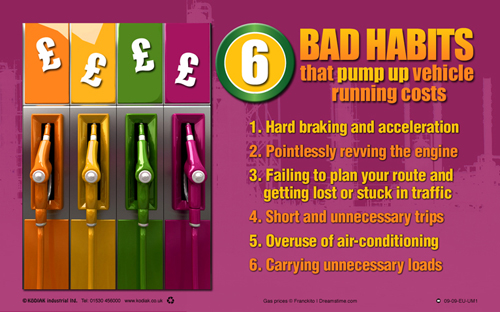
These ten simple eco-driving techniques can help you save fuel and money.

1. Drive smoothly 
Harsh braking and acceleration can increase your fuel consumption by up to 30%, so read the road ahead and allow yourself time to plan.

2. Avoid making short or unnecessary trips
Starting the engine from cold uses up to twice as much fuel, so only do it if you have a worthwhile journey to make.

3. Use the right gear 
Choosing an appropriate gear for the speed you are travelling at can save you up to 15% on your fuel bill.

4. Slow down
Travelling at 80 mph on the motorway, rather than the 70 mph speed limit, can increase your fuel consumption by up to 20%. Likewise, driving at 70 mph uses up to 20% more fuel than driving at 60 mph and 30% more than driving at 50 mph.

5. Take care of your vehicle
Regular servicing and maintenance keeps the engine at its most efficient – plus it keeps your vehicle running safely. A well-tuned engine can save you up to 10% on fuel, keeping your tyres inflated correctly can save you up to 3% and clean air filters can save up to 10%.

6. Plan your route
Motorists waste 350,000 tonnes of fuel each year by getting lost. Good route planning can help you avoid this and other common problems such as roadworks and congestion.

7. Ditch the air-conditioning when travelling below 60 mph
Having the air-conditioning switched on uses up to 25% more fuel. If you are travelling below 60 mph it's more economical to open a window.

8. Avoid idling
Your engine should be turned off whenever you are stationary. An idling engine produces up to 80% more pollution than a moving vehicle. Also, restarting the engine actually uses less fuel than 10 seconds' idling.

9. Avoid revving the engine
It is pointless and it only wastes fuel. Be aware that if you are stationary with your foot hovering on the accelerator you may be revving unintentionally.

10. Reduce weight
 Remove any unnecessary items from your vehicle, especially things such as empty roof-racks and boxes, which also create drag.

Kodiak's motivational poster programme regularly covers fuel economy and eco-driving.
If you would like to find out more about how our posters can keep your drivers reminded of fuel efficient driving techniques, please contact us.


For daily tips on dealing with common workplace issues, why not follow us on Twitter.
If you would like to find out how Kodiak posters 
can help your business work smoother, smarter 
and safer, please call us on: 01530 456 000 
or email us.

Tuesday, 8 February 2011

Waste management: Four golden rules to avoid waste and save money

Recycling posters
1
Posters on reducing waste
2
Waste reduction posters
3


 Recently there have been reports of a growing complacency in businesses with regard to waste – particularly with regard to wasting paper and other consumables.

In a survey, conducted by research firm Loudhouse on behalf of Kyocera, it emerged that the average office worker uses around 10,000 sheets of paper every year – an estimated 6,800 of which are wasted. And paper is just the tip of the iceberg.

With frequent warnings about climate change and other environmental issues, all businesses have a responsibility to be more eco-aware and protect the environment. This means cutting back on wasteful habits and keeping resources out of landfills, where they may take years to decompose properly.

So how can we cut waste, save money and be kinder to the environment? These four golden rules may be well-known in principle, but how do they fare in practice?

1. Reduce
Start by looking at ways to reduce the amount of waste you create. For example, turning off the photocopier at night could save enough energy to produce more than 1500 copies. Double-sided printing can instantly save you up to 50% on your paper costs and using an ink-saving typeface, such as Ecofont, could save you up to 25% on toner and printer ink. Better still, introduce policies to eliminate unnecessary printing, such as emails, altogether. These are simple savings, but they all add up over time.

2. Repair
How many times have you thrown something away because it was broken? A chair with a loose fixing? A computer monitor with a faulty button? An electrical item that just stopped working? A simple repair can often get more mileage out of your existing equipment for a fraction of the money, and carbon emissions, needed to replace it.

3. Reuse
Did you know that if everyone in your company switched to a proper drinking mug you could save around 700 paper cups per person, per year? You could even encourage your employees to bring in their own mugs.

How often do you buy things like paperclips, elastic bands, boxes and jiffy bags? Many of these things can be reused, but often end up in the bin without a second thought, while money is wasted on new ones. What about writing pads? A bulldog clip and a stack of waste paper does the same job for less money.

If you have waste that you can't reuse, why not look into passing it on to someone who can? Artists are always looking for new materials to work with and other companies might be able to use those small offcuts that you can't.

Investing in reusable items, such as rechargable batteries and dry-wipe boards might seem more expensive at first, but will save you money in the long-term compared with disposable alternatives.

4. Recycle
If there is no way to reuse or repair an item, recycling is the next best option. Your employees should be aware of exactly which items can be recycled, either in their entirety or as stripped down parts. They should also understand the importance of keeping recyclable items clean and not contaminating them by disposing of other materials in the same bin.

If you would like to improve eco-awareness in your business, maybe we can help. We have a wide variety oforiginal poster designs covering all aspects of waste reduction.

To see more samples and find out how our posters can work for you, why not contact us.


For daily tips on dealing with common workplace issues, why not follow us on Twitter.
If you would like to find out how Kodiak posters 
can help your business work smoother, smarter 
and safer, please call us on: 01530 456 000 
or email us.

Tuesday, 18 January 2011

Increasing productivity: Five easy ways to become more efficient

Productivity posters
1
Workplace efficiency posters
2
Cost reduction posters
3


As Da Vinci once said 'Simplicity is the ultimate form of sophistication.' It's also true that if you're trying to cut out inefficient ways and streamline your operation it pays to start simply. Here are five things to help you get started.
  1. Check your existing equipmentIs it performing efficiently? Is there a leak that needs pugging? A blade that needs sharpening? A part that needs to be replaced or some software that needs to be updated? Are there enough tools to go around?
  2. Enlist the support of your employees
    Promote a positive attitude and pro-active approach to reducing waste and improving production. Ensure your employees understand why reducing waste is so important and that they know how they can help. Encourage them to report problems early and suggest time or energy-saving ideas. Involving your employees makes them feel more valued and gives you the insight you need to make positive changes.
  3. Be organisedDid you know that the average person spends a year of their life looking for things they have lost? Make sure all your tools, equipment and materials have a permanent home and that all staff know where they are kept. In addition, develop a work ethic where all employees tidy up after themselves and return items they have used to their rightful place.
  4. Plan aheadLeaving everything until the last minute creates unnecessary pressure, under which employees can become flustered and more prone to making mistakes. Encourage your employees to save time by doing what they can in advance. This might be assembling tools, organising parts or preparing materials.
  5. Get if right first time
    Rework takes up valuable time and uses up extra resources. Adopt a 'right first time' approach and encourage employees to check their work for quality/mistakes before they submit it.
If you like these ideas and would like to find a simple way to implement them in your company or organisation, we may have just the solution.

Kodiak's motivational poster programme regularly promotes these productive processes and continually reminds your employees of the need to manage their time efficiently and be less wasteful.

If you would like to find out more about how our posters can help your company to increase productivity, please get in touch.


For daily tips on dealing with common workplace issues, why not follow us on Twitter.
If you would like to find out how Kodiak posters 
can help your business work smoother, smarter 
and safer, please call us on: 01530 456 000 
or email us.

Tuesday, 21 December 2010

Wrapping up: Efficiency, economy and security over Christmas

Posters on finishing work properly
1
Workplace holiday security
2
Energy-saving posters
3


It's that time of year again when, hopefully, everyone is in good spirits and winding down for the holidays.

With all the festivities and merriment it's easy to forget those last-minute details that can be so important.

For example, leaving work unfinished. A loose end here and there may not seem like a big deal before Christmas, when it's all fresh in your mind. But what about after Christmas, when you return to work and realise you have forgotten what it was all about? Or, worse still, a colleague is unexpectedly off sick and you have to take over their abandoned task without any instructions?

The advice is simple: finish everything you can. If you can't finish a job, for any reason, leave a clear reminder for yourself, which would also serve as instructions for a colleague in the event of your absence.

Turning off equipment is another important detail that can often be forgotten. Especially when you consider that a business can waste up to £500 over Christmas just by leaving equipment on stand-by.

Finally, it's vital to ensure the security of the premises. An open window or door could be an open invitation to an opportunistic thief.

If everyone takes some responsibility for turning off equipment (at the mains wherever possible) and securing access points in their area the whole process becomes much simpler.

As the Kodiak poster programme is supplied on a monthly basis, it is geared to providing seasonal information and reminders like this, as you need them, throughout the year.

Anything specific to your site, that cannot be covered in the main programme, can be addressed via our excellent custom poster service.

If you would like more information on how Kodiak's poster programme can make your workplace a better place in 2011, why not give us a call. We'd love to hear from you.


For daily tips on dealing with common workplace issues, why not follow us on Twitter.
If you would like to find out how Kodiak posters 
can help your business work smoother, smarter 
and safer, please call us on: 01530 456 000 
or email us.